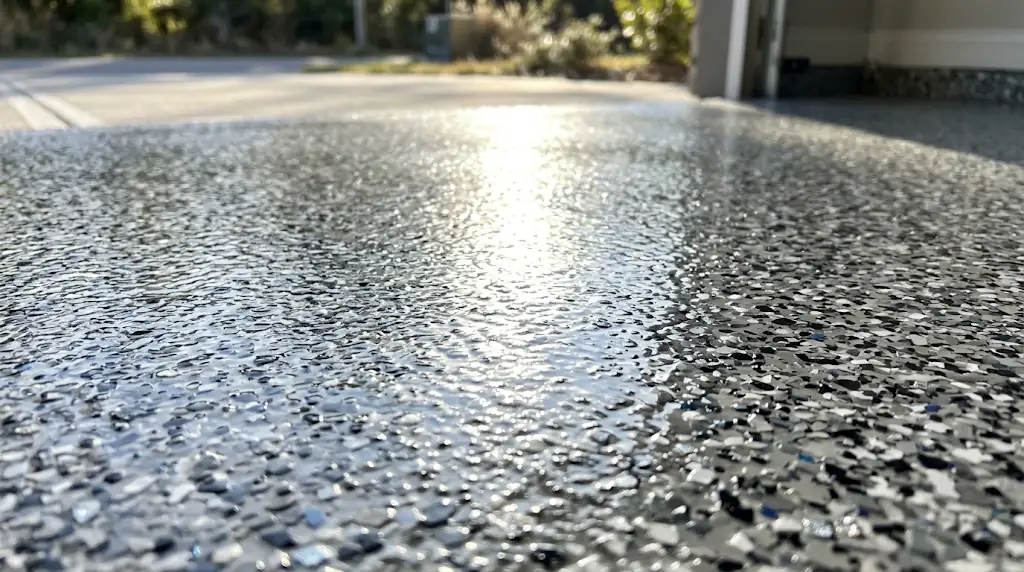
In the Greater Austin area, a professionally installed multi-layer epoxy floor lasts between 10 and 20 years, even when subjected to extreme summer heat and daily vehicle traffic. DIY epoxy paint kits fail within 1 to 3 years under Central Texas climate conditions due to thermal shock, UV degradation, and plasticizer migration.
Why Central Texas Heat Challenges Garage Floor Coatings
Central Texas summers routinely bring temperatures above 100°F. According to historical weather tracking from the National Weather Service Austin/San Antonio Office, the Austin metro corridor experiences dozens of triple-digit days each summer, with ground surface temperatures running significantly hotter than ambient air.
A concrete garage slab acts as a thermal heat sink. When ambient outdoor temperatures reach 102°F in Round Rock or Pflugerville, enclosed garage air frequently hits 115°F, and concrete surface temperatures can exceed 130°F.
Three specific climate-driven factors degrade garage floor coatings across Central Texas:
- Thermal Cycling and Concrete Expansion: Concrete slabs expand and contract as daytime heat peaks and overnight temperatures drop. Cheap coatings lack the elongation properties required to move with the slab, leading to micro-fractures, delamination, and peeling.
- Moisture Vapor Transmission (MVT): The USDA Natural Resources Conservation Service Web Soil Survey classifies much of the soil in Williamson and Travis counties—including Round Rock, Hutto, and Georgetown—as Houston Black clay. These expansive vertisols hold massive volumes of water. High soil moisture combined with intense surface heat creates vapor pressure that pushes upward through the concrete pores, popping brittle coatings off the substrate.
- Hot Tire Pick-Up: After driving on Interstate 35 or Highway 183 during July, passenger vehicle tires reach temperatures between 130°F and 175°F. Parking a hot vehicle on a substandard coating causes “hot tire pick-up,” where tire plasticizers bond with the floor paint and physically tear it away as the tire cools and contracts.
Coating Durability Comparison in the Greater Austin Area
Coating systems perform differently under Central Texas heat, heavy vehicle loads, and ground movement:
| Coating Type | Expected Lifespan in Austin Metro | Hot Tire Pick-up Resistance | UV Resistance | Moisture Vapor Tolerance |
| Water-Based DIY Epoxy Paint | 1–3 Years | Very Low (Peels within 12 months) | Poor (Yellows rapidly) | < 3 lbs / 1,000 sq ft / 24 hrs |
| Solvent-Based 1-Part Epoxy | 2–4 Years | Low | Poor to Moderate | < 3 lbs / 1,000 sq ft / 24 hrs |
| Solid Base Epoxy + Polyaspartic Topcoat | 15–20+ Years | Maximum (Chemical & thermal bond) | High (Aliphatic UV blockers) | Up to 20+ lbs / 1,000 sq ft / 24 hrs (with vapor barrier primer) |
| Polished Bare Concrete | 20+ Years | N/A (No film to peel) | N/A | High (Breathes naturally, but unsealed against oils) |
Critical Factors That Determine Coating Longevity
Longevity depends on chemistry and mechanical preparation, not marketing claims.
1. Mechanical Concrete Profiling
Acid etching with muriatic acid is insufficient for Central Texas concrete. Dense limestone-aggregate slabs require mechanical diamond grinding or shot blasting to achieve an International Concrete Repair Institute (ICRI) Concrete Surface Profile (CSP) of 2 to 3. This opens the concrete capillaries so the base coat can fuse mechanically into the slab.
2. Moisture Mitigation Primers
Because Central Texas clay soils retain moisture beneath residential foundations, moisture testing is mandatory before installation. Testing concrete moisture content according to ASTM standards—such as ASTM F2170 for relative humidity within the slab—identifies whether an epoxy moisture vapor barrier primer is required. A 100% solids epoxy moisture-blocking primer resists up to 20 lbs of moisture vapor pressure per 1,000 square feet over 24 hours.
3. Full-Broadcast Flake Layers
A full broadcast of vinyl color chips provides three functional benefits:
- Absorbs impact from dropped tools and equipment.
- Adds mechanical thickness (building the system to roughly 30–35 mils total).
- Eliminates weak spots across the surface by locking in the underlying epoxy layer.
4. Polyaspartic or Polyurethane Clear Topcoat
Pure epoxy chalks, turns amber, and degrades when exposed to ultraviolet radiation. Garage aprons and open garage doors in Texas receive direct sun exposure daily. Applying an aliphatic polyaspartic topcoat over the epoxy base ensures 100% UV stability, chemical resistance against battery acid and motor oil, and thermal tolerance up to 300°F.
Regional Service Lifespan Expectations
Slight variations in local geology and residential construction methods affect floor coatings across our service area:
- Round Rock, TX: Neighborhoods near the brushy limestone cuts along FM 1431 and University Boulevard feature dense foundation slabs. Professional systems last 15 to 20 years here with proper diamond grinding.
- Georgetown & Liberty Hill, TX: Rapid new construction on shallow limestone bedrock experiences slab settling cracks during seasonal shifts. High-tensile polyurea joint fillers are necessary before coating to achieve a 15-year floor life.
- Pflugerville & Hutto, TX: Slabs poured over deep blackland prairie clay soils experience the highest seasonal moisture heave. Installing a dedicated moisture barrier base coat is required to guarantee 15+ years of adhesion.
- Cedar Park & Leander, TX: Extreme summer sun exposure on west-facing garage doors requires double-layer polyaspartic topcoats to prevent UV discoloration over a 15- to 20-year span.
Maintenance Guidelines to Maximize Floor Lifespan
Following a structured maintenance routine protects the topcoat from abrasive wear and preserves its chemical bond:
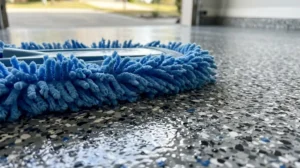
- Sweep Abrasive Grit Weekly: Central Texas wind carries limestone dust and coarse dirt into garages. Sweeping with a soft bristle broom or microfiber dust mop prevents surface abrasion under vehicle tires.
- Neutral pH Cleaning: Wash the floor every 3 to 6 months using clean water and a neutral pH floor cleaner. Avoid vinegar, bleach, citrus cleaners, and ammonia, which degrade gloss and break down clear topcoats over time.
- Prompt Fluid Clean-up: While polyaspartic topcoats resist automotive fluids, wipe up hot engine oil, brake fluid, and gasoline spills within 48 hours to eliminate staining risks.
- Use Protection Under Kickstands: Place a protective pad under motorcycle kickstands or heavy jack stands to avoid point-load gouging on hot summer afternoons.
Schedule a Concrete Evaluation in the Greater Austin Area
High summer heat does not mean your garage floor coating is destined to peel, bubble, or crack. Protecting your concrete requires commercial-grade moisture barriers, diamond grinding, and heat-resistant topcoats engineered specifically for Central Texas weather and soil conditions. Contact Round Rock Epoxy Flooring today through our contact page to schedule an on-site moisture test and concrete assessment for your garage or commercial facility.