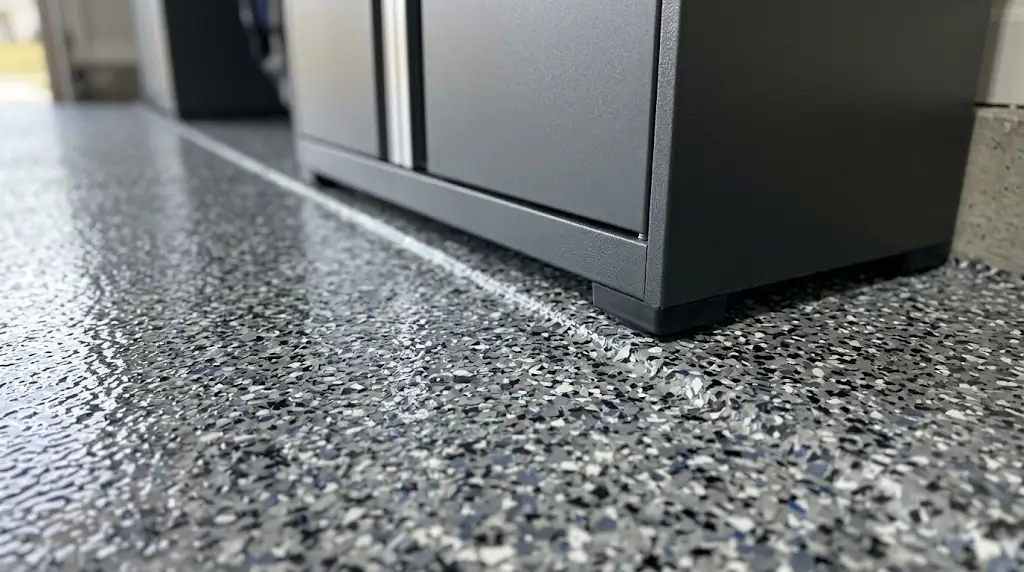
In the Greater Austin area, professional garage epoxy flooring costs between $4 and $12 per square foot, with most homeowners paying $2,200 to $4,400 for a standard 400-to-500-square-foot two-car garage. Final pricing depends primarily on mechanical surface preparation, slab moisture mitigation, and whether you install a solid-color epoxy, full-broadcast flake system, or premium polyaspartic topcoat.
Garage Epoxy Flooring Cost by Garage Size
Square footage is the primary baseline for pricing, though larger garages typically cost less per square foot due to equipment mobilization and setup efficiencies.
| Garage Size | Approximate Square Footage | Solid Color Epoxy ($4–$7/sq ft) | Full Flake System ($6–$10/sq ft) | Premium Polyaspartic / Metallic ($8–$15/sq ft) |
| 1-Car Garage | 200–300 sq ft | $800–$2,100 | $1,200–$3,000 | $1,600–$4,500 |
| 2-Car Garage | 400–500 sq ft | $1,600–$3,500 | $2,400–$5,000 | $3,200–$7,500 |
| 3-Car Garage | 600–800 sq ft | $2,400–$5,600 | $3,600–$8,000 | $4,800–$12,000 |
| 4-Car / Workshop | 900–1,200+ sq ft | $3,600–$8,400 | $5,400–$12,000 | $7,200–$18,000 |
Cost Breakdown by Coating System
Different coating formulas deliver varying levels of durability, chemical resistance, and UV protection under Texas heat.
1. Solid-Color 100% Solids Epoxy ($4 – $7 per sq ft)
- Design: Single solid color with a protective clear coat.
- Best For: Light storage areas, utility rooms, or budget-focused residential projects.
- Lifespan: 5 to 10 years.
- Limitations: Shows tire scuffs more visibly than textured floors and provides lower slip resistance when wet.
2. Full-Broadcast Flake System ($6 – $10 per sq ft)
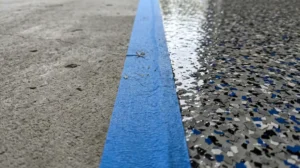
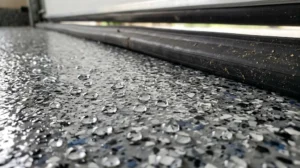
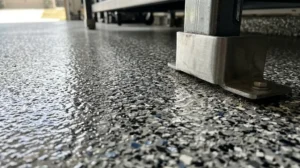
- Design: High-solids epoxy base coat, 100% flake coverage rejection layer, and an aliphatic polyaspartic clear topcoat.
- Best For: High-traffic garages, residential workshops, and homes with multiple vehicles.
- Lifespan: 15 to 20 years.
- Advantages: Hides substrate imperfections, provides permanent slip texture, and completely shields against hot tire pick-up.
3. Metallic Epoxy ($10 – $15 per sq ft)
- Design: Multi-layered, self-leveling clear epoxy infused with metallic pigments manipulated by hand to create marble or three-dimensional ripple effects.
- Best For: Showrooms, man caves, and high-end residential interior spaces.
- Lifespan: 10 to 15 years.
- Limitations: Requires pristine slab conditions and intensive labor; shows surface dust quickly.
Regional Price Variables in Central Texas
Quote ranges across Williamson and Travis counties fluctuate based on structural slab conditions and regional environmental challenges:
- Slab Diamond Grinding ($0.75 – $1.50 per sq ft if billed separately): Professional contractors use heavy planetary grinders equipped with diamond tooling to grind concrete to a profile recommended by the International Concrete Repair Institute (ICRI). Acid etching cannot adequately open dense Central Texas concrete pores.
- Moisture Vapor Barrier Primers ($1.00 – $2.00 per sq ft): Central Texas soils contain high concentrations of expansive clay that trap subsurface groundwater. If a moisture test exceeds 3 lbs per 1,000 sq ft per 24 hours under ASTM F1869, installing a 100% solids epoxy moisture mitigation base coat prevents floor delamination.
- Crack and Spall Repair ($3.00 – $8.00 per linear foot): Foundation settlement caused by shrinking and swelling soil frequently produces structural cracks across garage slabs in Round Rock, Georgetown, and Pflugerville. Technicians chase cracks with diamond blades and inject elastomeric polyurea fillers before coating.
- Removal of Failed DIY Coatings ($1.50 – $3.00 per sq ft): Stripping failing water-based epoxy paints or box-store sealers requires diamond grinding passes with specialized PCD (polycrystalline diamond) scrapers to clean the concrete pore structure.
Real Cost Comparison: DIY Kits vs. Professional Installation
Box-store DIY epoxy kits appear economical upfront, but long-term maintenance costs tell a different story:
| Expense Category | DIY Epoxy Kit (Home Improvement Store) | Professional Epoxy / Polyaspartic System |
| Material Cost (2-Car Garage) | $250–$500 (Water-based kits & decorative chips) | Included in quote ($2,400–$4,500 total) |
| Tool Rentals & Consumables | $300–$600 (Grinder rental, vacuum, rollers, spikes) | Included in contractor labor |
| Moisture Testing & Barrier | Rarely included (Adds $150–$300) | Included as standard protocol |
| Expected Service Life | 1–3 Years before hot tire peel | 15–20+ Years |
| 5-Year Cost of Ownership | $800–$1,400+ (Includes stripping & recoating) | $0 in repairs or recoats |
| Warranty Coverage | None | 10-to-15-year warranty on peeling & adhesion |
DIY water-based epoxies are typically 40% to 60% solids, meaning nearly half the applied material evaporates as water while drying, leaving a fragile 2- to 3-mil film. Professional industrial coatings are 100% solids, leaving a dense 30- to 35-mil high-build protective barrier that fuses into the slab.
Local Pricing Breakdown Across Our Service Cities
Site conditions and home ages subtly alter concrete prep requirements across our service footprint:
- Round Rock & Pflugerville: Established neighborhoods built between 1995 and 2010 frequently exhibit settling cracks and oil stains. Crack chasing, degreasing, and spot repairs average an additional $200 to $450 per project.
- Hutto & Taylor: Expansive blackland soil yields higher slab vapor transmission rates. High-performance moisture-blocking epoxy primers are standard line items to ensure full adhesion.
- Georgetown, Cedar Park & Leander: Slabs poured over limestone bedrock remain relatively level, but dense concrete hardeners used by builders necessitate coarse-grit diamond grinding (16- to 30-grit diamonds) to profile the slab properly.
- Liberty Hill: New construction homes typically require minimal surface patching, keeping installation costs at the lowest baseline price tier of $5.50 to $7.50 per square foot for full flake installations.
How to Get an Accurate Floor Coating Estimate
Contractor quotes should always itemize concrete preparation, crack repair, primer type, coating thickness (in mils), and clear topcoat chemistry.
Avoid estimates that rely solely on acid etching or do not include an on-site moisture evaluation. Protecting your garage floor from Central Texas heat requires a coating system engineered to withstand thermal cycling and high moisture vapor pressure. Contact Round Rock Epoxy Flooring through our contact page to schedule a detailed on-site assessment and receive a firm, written quote for your garage.