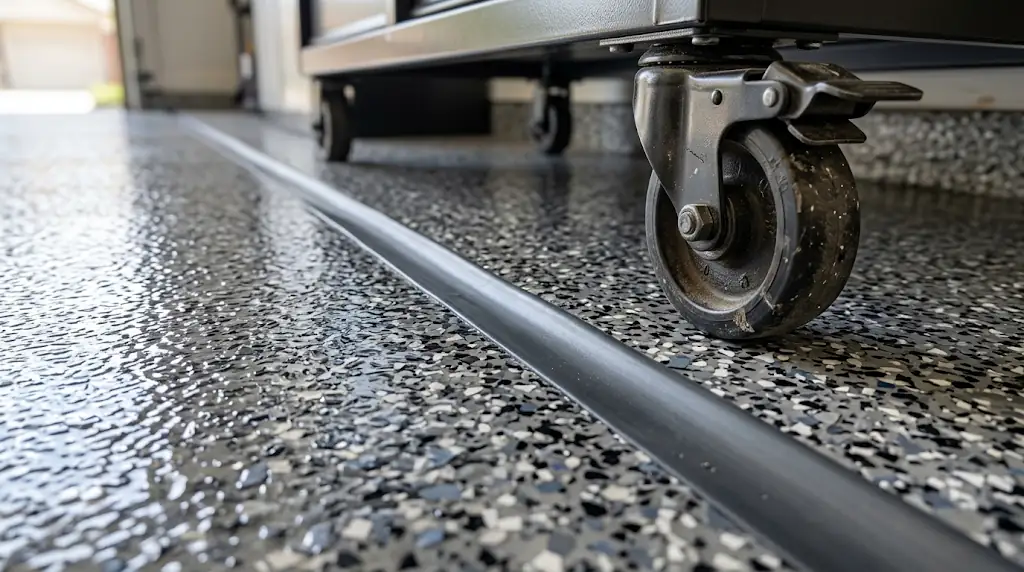
Professional epoxy flooring can withstand Central Texas soil movement when installed over properly prepped concrete, but standard epoxy coatings cannot prevent or bridge active, moving foundation fractures. Slabs built over expansive clay require elastomeric polyurea crack treatment and flexible moisture-mitigating primers to prevent hairline shifts from cracking the floor coating.
Why Central Texas Soils Cause Concrete Cracking
Central Texas sits over two distinct, challenging geological zones: the Balcones Fault zone and the Texas Blackland Prairie belt. The USDA Natural Resources Conservation Service identifies dominant local soils—such as the Houston Black series—as Vertisols, which contain high concentrations of montmorillonite clay.
Expansive vertisol clays have a high Plasticity Index (frequently exceeding 50). This chemical structure causes the ground to swell by 3 to 6 inches when saturated and shrink drastically during extended summer droughts.
This extreme shrink-swell movement places tremendous physical stress on residential concrete slabs:
- Edge Drop and Edge Lift: During dry summer months, soil around garage perimeters loses moisture faster than the soil beneath the center of the home. The slab perimeter drops, creating shear stress. During fall flash floods, edge lift occurs, cracking unreinforced or thinly poured concrete.
- Differential Settlement: Variations in soil moisture cause one corner of a garage foundation to settle while another remains fixed, causing diagonal and horizontal tensile fractures across the garage floor.
- Control Joint Separation: Concrete expands and contracts with ambient temperature shifts. When combined with underlying clay heave, pre-cut builder control joints shift out of alignment.
Static Cracks vs. Dynamic Cracks: What Can Epoxy Handle?
Not all concrete fractures behave the same way under a resinous floor coating:
| Crack Type | Cause & Movement Profile | Can Epoxy Bridge It? | Required Professional Repair Method |
| Micro-Crazing / Shrinkage | Rapid surface curing of concrete (Non-moving) | Yes | Diamond grinding + 100% solids base coat |
| Static Cracks (< 1/4 inch) | Initial settling shortly after construction (Non-moving) | Yes | Diamond blade crack chasing + rigid structural epoxy injection |
| Dynamic / Working Cracks | Ongoing foundation movement from expansive clay (Active movement) | Conditionally | Elastomeric polyurea or flexible joint sealant |
| Heaved / Offset Cracks | Vertical displacement across the crack (One side higher than the other) | No | Diamond cup grinding to flush plane + stitched carbon-fiber staples |
Professional Prep Protocols for Expansive Soils
Applying epoxy directly over cracked concrete without mechanical stabilization causes the coating to snap or delaminate within months. Professional installation requires a four-step remediation protocol:
1. Mechanical Crack Chasing
Installers chase surface cracks using a diamond-tipped crack-chaser blade on an angle grinder. Chasing creates a clean, uniform “V” or “U” groove, removing loose, crumbly aggregates and allowing repair polymers to reach deep into the slab core.
2. High-Tensile Polyurea or Epoxy Mortar Injection
Rigid fillers snap under lateral stress. Installers inject rapid-curing, two-component polyurea or structural epoxy compounds conforming to standards such as ASTM C881 (Standard Specification for Epoxy-Resin-Base Bonding Systems for Concrete). Low-viscosity polyurea penetrates the pores of the crack walls, cures stronger than the original concrete, and grinds flush within 30 minutes.
3. Control Joint Strategy
Builder control joints (the straight saw cuts added during construction) must be handled carefully. Sealing them flush creates a seamless, aesthetic floor, but ongoing soil heave will eventually stress those lines. Flexible polyurea joint fillers allow minimal slab movement while preventing water, motor oil, and debris from penetrating beneath the foundation.
4. High-Elongation Base Primers
Standard brittle epoxies have less than 5% elongation before breakage. Modern hybrid systems utilize moisture-vapor-tolerant epoxy or polyurea primers with superior flexural strength, absorbing baseline thermal expansion and micro-shifts without blistering or tearing away from the slab.
Soil and Foundation Realities Across Service Areas
Central Texas geology is not uniform. The specific risk to your garage slab depends on your exact municipality:
- Round Rock & Pflugerville: Located squarely within the Blackland Prairie corridor. Garage floors here regularly experience deep shrinkage cracks during July and August heatwaves. Moisture vapor barriers and structural crack chasing are mandatory for long-term coating adhesion.
- Hutto: Features some of the deepest vertisol clay layers in Williamson County. Garages in Hutto show higher rates of dynamic crack movement, requiring flexible polyurea joint treatments rather than rigid sand-epoxy patches.
- Georgetown & Liberty Hill: Slabs often sit on shallow caliche and Edwards limestone. These soils swell less than prairie clay, but thin soil layers cause direct transfer of bedrock settlement shocks, producing long, straight stress-fracture lines across garage entrances.
- Cedar Park & Leander: The Balcones transition zone features a patchwork of clay pockets and limestone ledges. Slabs built across uneven sub-bases frequently show differential settling, requiring diamond planar leveling prior to epoxy coating.
Evaluating Your Floor Before Coating
Before applying an epoxy floor, check your garage slab for these warning signs:
- Cracks with vertical displacement where one side sits higher than the other.
- Hairline cracks that visibly widen in August and narrow in January.
- White powder (efflorescence) pushing out along crack lines, indicating pressurized groundwater rising from sub-slab clay.
If active structural movement is present, foundation leveling should occur before applying decorative floor coatings. Once the foundation is stabilized, professional surface grinding and elastomeric crack repair ensure that your high-solids epoxy or polyaspartic coating remains bonded for decades.
Protect Your Central Texas Garage Floor
Central Texas clay soil presents challenging conditions for concrete slabs, but proper crack remediation and flexible industrial coatings prevent surface failures. Contact Round Rock Epoxy Flooring today through our contact page to book an in-person concrete evaluation, moisture test, and customized quote for your garage.