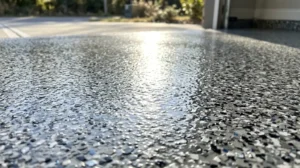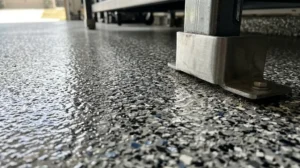
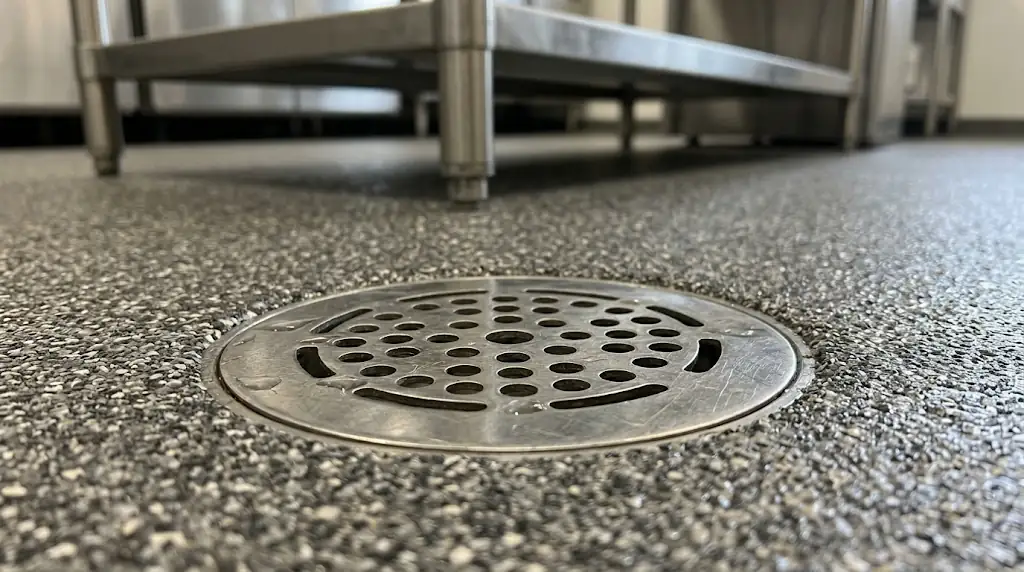
Yes, commercial epoxy flooring can fully meet and exceed Williamson County and Texas Department of State Health Services (DSHS) health and safety codes when installed with seamless cove bases, non-porous antimicrobial topcoats, and certified slip-resistant textures. Regulatory agencies require floors in food service, healthcare, and industrial facilities to be smooth, non-absorbent, easily cleanable, and free of open joints or cracks where pathogens can harbor.
Williamson County Regulatory Framework for Commercial Floors
Commercial facilities across Williamson County—including Round Rock, Georgetown, Cedar Park, Leander, and Hutto—are governed by strict sanitation and public health regulations. The Williamson County and Cities Health District (WCCHD) conducts environmental health inspections based on the Texas Food Establishment Rules (TFER) administered by the Texas Department of State Health Services.
Under TFER §228.171 and §228.172, physical facility floors must adhere to three non-negotiable standards:
- Impervious and Non-Absorbent Surfaces: Floor materials in food prep areas, dishwashing stations, walk-in coolers, and restrooms must resist water, grease, organic food acids, and chemical cleaners. Bare or inadequately sealed concrete fails inspection due to porosity.
- Seamless Construction and Integrated Cove Base: The floor-to-wall junction must be sealed and coved with a minimum 4-inch radius curve. This eliminates 90-degree corners where organic matter, grease, and stagnant water accumulate.
- Continuous Cleanability and Drainage: Surfaces must withstand routine high-pressure washing, hot water sanitization, and chemical sanitizers without pitting, blistering, or eroding.
Commercial Epoxy vs. Health and Safety Code Standards
Commercial-grade resinous systems solve the common compliance failures associated with tile grout and bare concrete:
| Health & Safety Requirement | Quarry Tile / Ceramic Tile | Bare / Sealed Concrete | Commercial Polyaspartic / Epoxy System |
| Non-Porous / Water-Impervious | Tile is non-porous, but grout lines absorb liquids | Highly porous (Absorbs grease, bacteria, chemicals) | 100% Non-porous, monolithic cross-linked membrane |
| Joint Sanitation (No Bacterial Grout Lines) | Fails: Grout degrades, harbors Salmonella and Listeria | Fails: Control joints trap organic matter | Passes: 100% seamless; joints filled with flexible polyurea |
| Integrated 4-Inch Sanitary Cove Base | Requires separate cove tiles (Grout lines fail over time) | N/A (Standard framing junction) | Seamless troweled resin cove base integral to the floor |
| Chemical & Sanitizer Resistance | Moderate (Bleach and citrus degrade standard grout) | Low (Acids and chemicals dissolve concrete paste) | Exceptional (Withstands harsh sanitizers, oils, and acids) |
| Slip-Resistance (ADA / OSHA Compliance) | Low when wet or contaminated with cooking oil | Low when smooth-troweled | Passes: Customizable slip resistance (0.60+ DCOF) |
Key Compliance Engineering: Meeting Local Inspector Demands
Commercial resinous floor installations in Williamson County rely on specific design components to guarantee compliance during final building and health inspections:
1. Integral Troweled Coving (4″ to 6″ Sanitary Base)
Instead of installing stick-on rubber baseboards or perimeter tile, technicians install an integral epoxy mortar cove base. Installers trowel a blended epoxy mortar up the vertical wall 4 to 6 inches, finishing it with a smooth, concave radius at the bottom transition. This creates an unbroken, bathtub-like seal that prevents wash water and pests from penetrating behind sheetrock or wall panels.
2. Thermal Shock and Hot Water Washdown Tolerance
Commercial kitchens, microbreweries, and bakeries subject floors to boiling water washdowns and steam discharge. Standard thin-mil paints delaminate under thermal shock. High-performance urethane cement slurries or 100% solids epoxy systems withstand rapid temperature swings from 32°F (freezer washouts) up to 220°F (fryer boil-outs) without cracking or lifting.
3. Dynamic Coefficient of Friction (DCOF) and ADA Safety Standards
Workplace slip-and-fall injuries represent a primary focus for OSHA and building compliance. Under the Americans with Disabilities Act (ADA) Standards for Accessible Design, commercial walkways must maintain slip-resistant surfaces. Installers broadcast aluminum oxide or micronized polypropylene aggregate into the intermediate and top coats, achieving a Dynamic Coefficient of Friction (DCOF) rating exceeding the 0.42 wet standard outlined in ANSI A326.3.
4. Antimicrobial Topcoats
For medical clinics, veterinary hospitals, and food production plants, aliphatic polyaspartic and urethane topcoats can be infused with EPA-registered antimicrobial agents. These ionic additives disrupt bacterial cell membranes on contact, actively inhibiting the growth of pathogens, mold, and mildew across the surface between scheduled cleanings.
Industry-Specific Code Applications Across Central Texas
Commercial facilities throughout Round Rock, Georgetown, Pflugerville, and nearby municipalities have distinct operational requirements:
- Commercial Kitchens & Restaurants: High concentrations of animal fats, hot fryer oils, and caustic dishwashing chemicals destroy standard flooring. Thick-build epoxy mortar or urethane concrete systems with full flake broadcasting and chemical-resistant topcoats withstand these harsh environments while passing WCCHD food inspections.
- Veterinary Clinics & Kennels: Animal urine contains urea and ammonia that corrode raw concrete and permeate unsealed grout lines. A completely seamless, chemical-resistant resin floor with integrated cove base eliminates odor absorption and withstands hospital-grade disinfectant washes.
- Automotive Repair Shops & Dealerships: Williamson County facilities must prevent automotive fluids (brake fluid, motor oil, and battery acid) from contaminating concrete substrates. High-build epoxy-polyaspartic coatings resist chemical etching and hot tire pick-up from heavy commercial vehicles.
- Breweries & Beverage Production: Facilities throughout Liberty Hill and Cedar Park handle organic fruit acids, hot wort runoff, and intense keg impact. Thermal shock-resistant urethane cement slurries prevent the delamination typical of standard paints exposed to hot liquids.
Preparing for Commercial Health & Fire Inspections
When designing a commercial floor to satisfy Williamson County inspectors:
- Verify Pitch and Drainage Alignment: Ensure concrete is mechanically sloped toward trench drains so water does not pool in low spots, which is an immediate inspection failure under TFER codes.
- Seal All Expansion Joints: Pre-cut expansion and isolation joints must be detailed with flexible, food-grade elastomeric polyurea that moves with building vibration without opening bacterial collection voids.
- Request Material Safety and Compliance Documentation: Maintain manufacturer technical data sheets (TDS) on-site confirming low or zero VOC emissions, USDA/FDA compliance ratings for indirect food contact, and ASTM flame spread ratings under ASTM E648.
Build a Code-Compliant Commercial Facility
Passing local health, fire, and safety inspections requires flooring that delivers permanent sanitary barriers, durable chemical resistance, and certified traction. Whether you are opening a restaurant, upgrading a veterinary clinic, or outfitting a cleanroom, industrial resinous systems provide the structural endurance necessary to meet all municipal standards. Contact Round Rock Epoxy Flooring today through our contact page to review your facility blueprints, run an on-site concrete assessment, and receive a code-compliant flooring proposal.