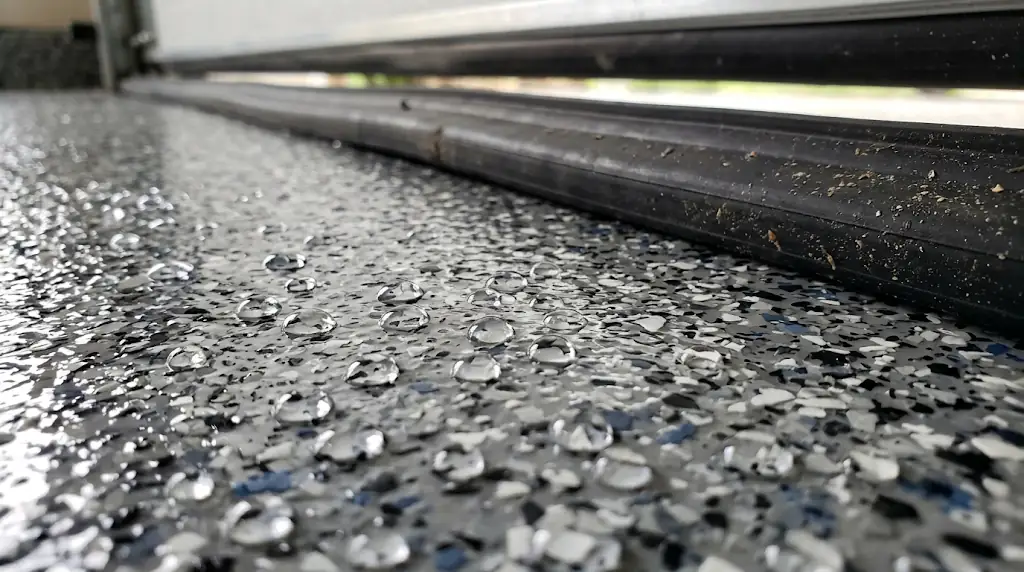
Yes, professional epoxy flooring is fully waterproof against surface rainwater and ambient humidity, but standard epoxy will fail if underlying moisture vapor from Central Texas soil pushes upward through the concrete slab. In the Austin metro area, lasting moisture resistance requires a dedicated 100% solids epoxy moisture vapor barrier primer capable of blocking high hydrostatic pressure.
Surface Water vs. Sub-Slab Vapor: The Two Sides of Moisture
To understand moisture resistance in Central Texas, homeowners must distinguish between moisture hitting the top of the floor and moisture rising from beneath it.
| Moisture Type | Origin | Impact on Standard Epoxy | Solution Required |
| Top-Down Moisture | Rain runoff, vehicle drip, ambient humidity, washing | Completely impermeable; water sits on surface without penetration | Textured flake broadcast + chemical-resistant topcoat to prevent slips |
| Bottom-Up Vapor (MVT) | Groundwater trapped in expansive clay soils below the slab | Blisters, delaminates, and fractures brittle resin coatings | Deep diamond grinding + 100% solids epoxy moisture vapor barrier primer |
Why Central Texas Geology Drives Sub-Slab Moisture Pressure
The Greater Austin area is subject to weather patterns that swing violently between extended droughts and torrential downpours. When intense storms sweep through Williamson and Travis counties, moisture levels in the subsoil spike rapidly.
Central Texas foundations are heavily impacted by two underlying conditions:
- Expansive Vertisol Clays: Soils such as Houston Black clay expand significantly when wet, acting like an underground sponge that holds water against the concrete foundation for weeks after rainfall.
- Moisture Vapor Transmission (MVT): Concrete is porous, behaving like a hard sponge full of microscopic capillaries. As summer heat warms the top of the slab while the soil below stays saturated, water is drawn upward as gas. This vapor pressure pushes against the underside of garage floor coatings.
When upward vapor pressure exceeds the bond strength of a basic paint or non-vapor-rated coating, osmotic blistering occurs. The coating bubbles, fills with alkaline water, and peels away in sheets.
How Professional Coatings Handle Austin Metro Moisture
Achieving true moisture protection in Central Texas requires an engineered, multi-layered system designed to control both hydrostatic pressure below and standing water above.
1. Concrete Moisture Testing
Prior to installation, professional technicians measure slab moisture levels according to standardized industry protocols:
- Calcium Chloride Testing (ASTM F1869): Measures the moisture vapor emission rate (MVER) from the slab. Standard epoxies fail at rates above 3 lbs per 1,000 square feet per 24 hours.
- In-Situ Relative Humidity Probes (ASTM F2170): Measures internal slab relative humidity (RH). Readings above 75% to 80% require specialized remediation.
2. Moisture-Mitigating Epoxy Primers
If testing reveals elevated moisture vapor emissions, contractors install a specialized moisture-blocking primer. These low-viscosity, 100% solids epoxy formulas penetrate deep into the concrete’s open capillaries, reacting chemically to create an impermeable plug. High-performance primers can withstand up to 20 to 25 lbs of MVER and 95% internal relative humidity, neutralizing sub-slab vapor before the decorative base coat is applied.
3. Impermeable Polyaspartic Clear Coats
While the base coat anchors to the concrete, the topcoat must resist standing rainwater, road salt, automotive fluids, and high ambient humidity. Aliphatic polyaspartic coatings create a dense, cross-linked molecular shield that is completely non-porous. Rain blown in through an open garage door or tracked in from wet tires cannot penetrate the film.
Managing Rain and High Humidity Hazards: Slip Resistance
While epoxy systems are completely waterproof, a smooth, high-gloss floor becomes slick when wet vehicles pull in during heavy Texas thunderstorms.
Professional systems prevent slip hazards through two primary methods:
- Full-Broadcast Flake Texturing: Broadcasting color vinyl chips to complete rejection creates a multi-dimensional, textured surface profile reminiscent of orange peel, providing mechanical traction for shoes and tires.
- Aluminum Oxide Anti-Slip Additives: Clear topcoats can be infused with micronized polymer beads or aluminum oxide grit. This adds microscopic grip without diminishing the floor’s gloss or cleanability.
Regional Moisture Dynamics Across Service Areas
Different sectors of the Austin metropolitan area experience distinct moisture challenges based on terrain, soil type, and drainage:
- Pflugerville & Hutto: Sits on deep blackland prairie soils with slow drainage. Slabs retain water long after heavy rains, making moisture barrier base coats essential to prevent osmotic blistering.
- Round Rock: Varied terrain with mixed clay and limestone gravel. Neighborhoods along Brushy Creek often show higher moisture vapor readings due to elevated local water tables.
- Georgetown & Liberty Hill: Slabs set over shallow rock have less clay sponge action, but horizontal water runoff across limestone shelves frequently collects beneath exterior garage aprons, requiring dedicated joint sealing.
- Cedar Park & Leander: Karst limestone formations and steep elevation changes create rapid runoff during flash storms. Garage thresholds require UV-stable polyaspartic transitions to handle driving rain without yellowing or peeling.
Long-Term Floor Care in Humid Conditions
A moisture-sealed epoxy system requires minimal effort to stay clean and sanitary:
- Squeegee Heavy Rain Runoff: Central Texas thunderstorms can deposit standing water inside garage doors. A simple rubber squeegee clears surface water in seconds.
- Prevent Mold and Mildew Growth: Concrete pores harbor mildew when exposed to continuous moisture and humidity. Seamless, non-porous epoxy coatings eliminate the organic food source, preventing mold and musty odors.
- Inspect Expansion Joints Annually: Ensure exterior control joints remain sealed with elastomeric polyurea so surface stormwater cannot seep beneath the slab edges.
Protect Your Concrete from Central Texas Moisture
Extreme humidity and groundwater pressure can destroy inadequate floor paints, but an industrial moisture vapor barrier combined with a polyaspartic system provides permanent protection against both rain and sub-slab hydrostatic pressure. Contact Round Rock Epoxy Flooring today through our contact page to schedule an on-site moisture evaluation and concrete profile inspection.