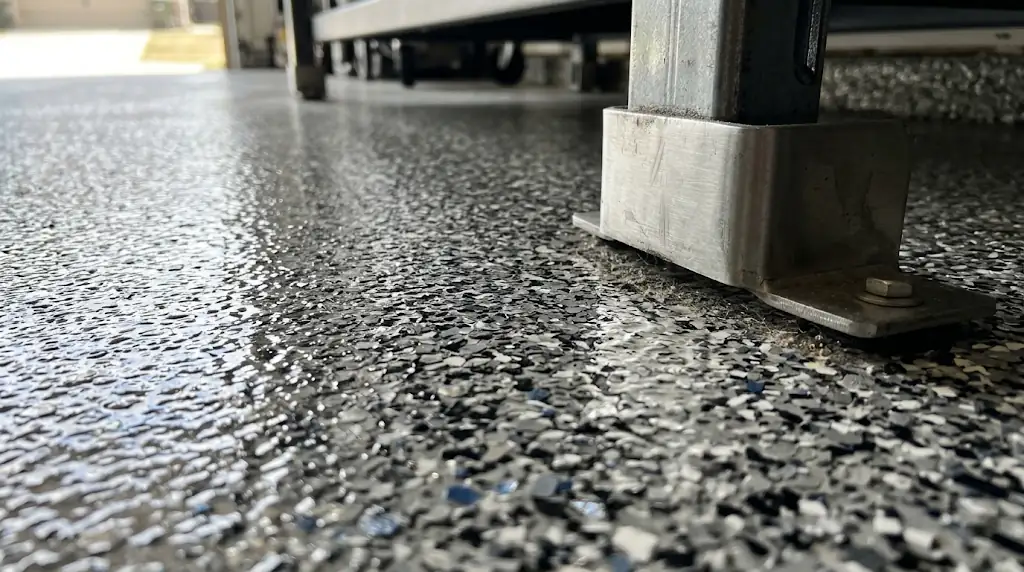
A professional full-broadcast flake epoxy system creates a seamless, 30-to-35-mil industrial barrier that lasts 15 to 20 years in Central Texas without peeling, chipping, or fading. In contrast, retail DIY epoxy kits leave a fragile 2-to-4-mil water-based film that typically fails within 12 to 24 months under the combined stress of triple-digit summer heat, hot tire pick-up, and concrete moisture vapor.
Technical Comparison: Full-Broadcast System vs. DIY Box Kit
The chemical composition, installation mechanics, and performance specs of professional multi-layer systems differ fundamentally from retail boxed kits:
| Feature / Specification | Professional Full-Broadcast System | Retail DIY Epoxy Kit (Big-Box Store) |
| Resin Formulation | 100% Solids Epoxy Base Coat | Water-Based or Solvent-Diluted Epoxy (40%–50% solids) |
| Finished System Thickness | 30 to 35 mils dry film thickness (DFT) | 2 to 4 mils dry film thickness (DFT) |
| Surface Profiling Method | Mechanical planetary diamond grinding (CSP 2–3) | Chemical acid etching (muriatic or citric acid wash) |
| Decorative Flake Density | Full broadcast to rejection (100% coverage, ~1.5 lbs/10 sq ft) | Sporadic cosmetic sprinkle (< 5% coverage, ~0.1 lbs/10 sq ft) |
| Protective Topcoat | Aliphatic Polyaspartic or Polyurea | Clear water-based epoxy or no topcoat provided |
| Pull-Off Adhesion Strength | > 400 psi (Concrete shears before coating fails) | 100–150 psi (Prone to adhesive delamination) |
| Hot Tire Pick-Up Threshold | 300°F+ (Tolerates high-friction summer driving) | 120°F–140°F (Softens and peels under hot tires) |
| UV Resistance | 100% UV-stable (Non-yellowing aliphatic chemistry) | Aromatic epoxy chemistry (Chalks and ambers in sunlight) |
| Expected Lifespan in Austin Metro | 15 to 20+ Years | 1 to 3 Years |
5 Critical Failure Points of DIY Kits in Central Texas
Understanding the performance gap requires evaluating the mechanical and chemical stresses specific to the Austin-Round Rock metropolitan corridor.
1. Solids by Volume and Dry Film Thickness (DFT)
Boxed retail kits rely on water or solvent carriers to keep the product workable for novice painters. When a 50% solids water-based epoxy dries, half of the wet volume evaporates into the atmosphere. This evaporation leaves behind an ultra-thin 2-to-4-mil membrane—comparable to two coats of standard latex wall paint.
A professional system utilizes 100% solids epoxy. Every ounce poured onto the slab cures into dense polymer, locking into the concrete capillaries. Combined with the broadcast vinyl chips and a heavy polyaspartic clear coat, the finished floor measures approximately 30 to 35 mils, providing ten times the structural thickness of a DIY paint layer.
2. Acid Etching vs. Mechanical Diamond Grinding
DIY kits advise homeowners to prepare concrete by scrubbing it with diluted muriatic or citric acid. In Central Texas, where residential slabs are poured with dense limestone aggregates and finished with power trowels, acid etching fails:
- Acid reacts only with the free calcium hydroxide on the slab surface; it cannot cut through curing compounds, motor oil saturations, or hard-troweled surfaces.
- Acid wash introduces gallons of water deep into the concrete slab, accelerating moisture failure under the new coating.
- According to the International Concrete Repair Institute (ICRI), coatings require a Concrete Surface Profile (CSP) of 2 to 3 for permanent mechanical bonding. Heavy planetary diamond grinders open the concrete’s micro-pores dry, creating millions of anchor points without introducing moisture.
3. Full Broadcast to Rejection vs. Cosmetic Sprinkles
In a DIY kit, decorative vinyl flakes are merely aesthetic chips tossed sparingly across wet paint.
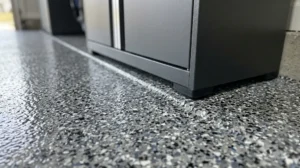
In a professional full-broadcast application, technicians throw hundreds of pounds of vinyl composite flakes into the wet 100% solids base until the floor rejects further material. This full broadcast provides three functional advantages:
- Impact Shield: Dropped heavy hand tools bounce off the dense vinyl flake matrix instead of chipping the underlying concrete.
- Uniform Texture: Flakes naturally create an orange-peel, non-skid surface profile that prevents slips when wet.
- Substrate Concealment: Complete flake coverage masks natural slab variations, patched control joints, and minor surface defects common in Central Texas foundations.
4. Topcoat Chemistry: Aromatic vs. Aliphatic Polymers
DIY kits typically finish with standard aromatic epoxy resins. Aromatic epoxies break down rapidly when exposed to ultraviolet light. Garage aprons and open garage doors in Texas allow harsh UV radiation to penetrate daily, causing retail epoxy to yellow, chalk, and lose cohesion within 12 to 18 months.
Professional systems seal the flake layer with an aliphatic polyaspartic topcoat. Aliphatic polymers feature alternating molecular chains that are impervious to UV rays. They resist discolouration, provide a glossy or satin sheen, and offer four times the abrasion resistance of standard epoxy.
5. Tensile Adhesion and Hot Tire Pick-Up
When a car exits Interstate 35, State Highway 45, or Highway 183 in July, tire treads frequently exceed 140°F. Parking a hot car on water-based epoxy causes the rubber plasticizers to soften the thin polymer film. As the vehicle cools, the contracting rubber pulls the epoxy away from the smooth, acid-etched concrete.
Evaluated under ASTM D7234 (Standard Test Method for Pull-Off Adhesion Strength of Coatings on Concrete), professional 100% solids epoxy systems achieve pull-off values exceeding 400 psi. At that force, the cohesive strength of the concrete substrate fails before the chemical bond separates.
10-Year Cost of Ownership Analysis
The apparent initial savings of a DIY epoxy kit diminish quickly when factored across a decade:
| Expense (Standard 2-Car Garage) | Professional Full-Broadcast Installation | DIY Epoxy Paint Kit (Repeated Cycles) |
| Year 1 Installation Cost | $2,400–$4,000 | $350–$600 (Kits, rollers, acid) |
| Year 3 Recoating / Repair | $0 | $400 (Patching peeled tire tracks) |
| Year 5 Complete Strip & Redo | $0 | $1,200 (Grinder rental, stripper, new kits) |
| Year 8 Failure Remediation | $0 | $1,500+ (Professional removal of failed layers) |
| 10-Year Total Investment | $2,400–$4,000 | $3,450–$3,700+ |
| Total Labor Hours Expended | 0 Hours | 40+ Hours of intense manual labor |
Regional Service Performance: Greater Austin Area
Local geology and builder specifications across Williamson and Travis counties demand professional preparation:
- Round Rock & Pflugerville: Slabs built over expansive blackland clay absorb high groundwater levels after heavy spring rains. Water-based DIY kits trap this vapor, causing immediate bubble blisters in summer heat.
- Georgetown & Liberty Hill: High limestone bedrock causes intense vibration transfer from street traffic and construction blasting. High-tensile, 35-mil full-broadcast floors absorb structural micro-shocks that shatter thin DIY coatings.
- Cedar Park & Leander: West-facing home sites face intense direct afternoon sunlight. Without an aliphatic polyaspartic topcoat, garage floor aprons turn yellow within one summer.
- Hutto: Garages subjected to fine, abrasive agricultural grit require high-taber abrasion resistance. Flake systems withstand surface scraping from yard equipment and dirty tires without scratching.
Upgrade Your Garage with Commercial-Grade Protection
A garage floor coating in Central Texas must withstand extreme slab temperatures, aggressive vehicle tire friction, and active soil movement. DIY kits provide a temporary cosmetic fix that fails under these conditions, while full-broadcast flake systems deliver permanent, industrial-grade concrete protection. Contact Round Rock Epoxy Flooring through our contact page to schedule a consultation and get a durable, professional floor built specifically for Central Texas conditions.